Why did California’s billionaire tax fail to surf the blue wave? : Planet Money : NPR
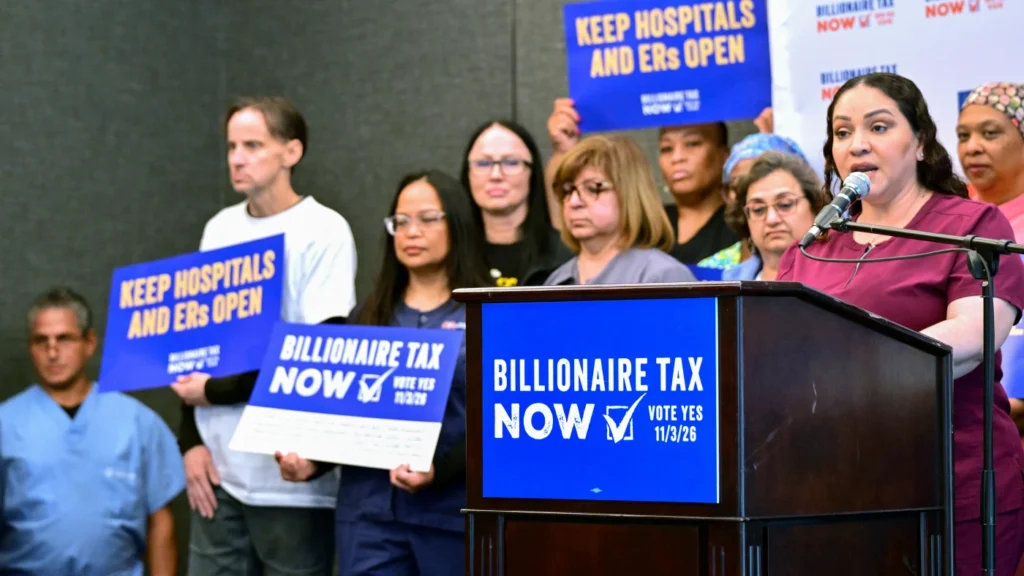

Ultrasound Technologist Mayra Castaneda speaks in front of healthcare workers holding placards in support of the Billionaire Tax during a media briefing in Los Angeles on April 27, 2026. Healthcare workers and allies outlined the next steps in their effort to get California’s Billionaire Tax on the ballot for the November election, with their efforts already exceeding 1,500,000 signatures collected from across the state. The initiative would levy a one-time 5% tax on California billionaires. (Photo by Frederic J. BROWN / AFP via Getty Images)
FREDERIC J. BROWN/AFP via Getty Images/AFP
hide caption
FREDERIC J. BROWN/AFP via Getty Images/AFP
Late Monday, The Associated Press determined that California voters had rejected Prop 40, the proposed billionaire wealth tax I wrote about last week. Given the big blue wave we saw during the midterms, why did this tax on billionaires fail to surf to victory?
To make sense of the results, I went back to the two economists I spoke with last week: UC Berkeley’s Gabriel Zucman, a leading champion of wealth taxes, and Stanford’s Joshua Rauh, a prominent critic of Prop 40.
Last week, they disagreed on what this wealth tax on billionaires would do to California’s economy and tax revenue. Now comes the sequel, in which they disagree on what the results say about the politics of wealth taxes.
Their debate could foreshadow a bigger one in the next Democratic presidential primary: should the party embrace a wealth tax?
Did billionaire money tip the scales?
Zucman blames the corrosive influence of money for Prop 40’s failure.
“I am not surprised,” Zucman says. Opponents of Prop 40 spent almost $400 million fighting it, including spending on competing ballot measures, making it one of the most expensive ballot initiative fights in history.
“The money spent by the billionaires was critical,” Zucman says. “Anyone who lives in California has been carpet-bombed by a deluge of ads. One can easily see how this could be pivotal in such a closely contested ballot.”
But didn’t Democrats win plenty of races this cycle despite huge sums spent against them? In Texas, for example, Elon Musk alone poured more than $150 million into defeating Democrat James Talarico. And Talarico ended up winning his Senate race by a comfortable margin. Why would money have been so decisive with Prop 40 and not in other races around the nation?
For one, Zucman says, the spending gap was much bigger in the fight over Prop 40. “The billionaires spent more than $300 million on ads versus negligible sums on the other side,” Zucman says. “On TV and in their mailboxes, voters were exposed only to the anti-tax arguments. This was very different from the other midterm races: in those races, when spending was high (e.g., Talarico vs. Paxton in Texas) it was high on both sides, even if unevenly. The net difference in spending was considerably larger for Prop 40.”
It’s also possible that money can matter more in ballot initiatives than in races between candidates. Analysts have complained for decades that California’s ballot initiative system is too easily manipulated by special interest groups. The nitty-gritty details of specific policies can get complicated, and many voters don’t take the time to get educated on them. That can give well-funded advertising campaigns more power to shape their views.
In candidate races, meanwhile, voters can at least fall back on name recognition or party labels, which give them an easy mental shortcut — what social scientists call a “heuristic” — when making decisions at the ballot box. Even when they know little about the candidates, they usually know which party they prefer.
But Prop 40 didn’t come with the same clear partisan signal. In fact, prominent Democrats, including California Gov. Gavin Newsom, came out against it. Newsom said he favored a national minimum tax on billionaires instead.
Or was this tax policy itself the problem?
“Popular opinion on wealth taxes is clearly not as strong as proponents thought,” Rauh says.
Rauh questions whether money and advertising can really explain Prop 40’s poor showing. He compared support for the tax with support for Kamala Harris in the 2024 presidential election. In some of “the most progressive Bay Area counties,” he says, Harris won overwhelming support while Prop 40 won much less. This gap between support for Harris and support for Prop 40 was bigger there than it was in other Democratic-leaning counties across the state.
If advertising was the main explanation for this tax’s poor showing, he argues, why was the gap so much bigger in the Bay Area? Sure, he says, advertisers may have done more targeting there, but he thinks the uneven pattern across the state casts doubt on the idea that advertising was the decisive factor.
“[T]he counties with the largest defections are actually the ones whose residents are most likely to know a billionaire, to work for one, or to have watched one move to Texas or Florida,” Rauh writes in a recent post. “The simple reading is that proximity to the people being taxed, and to the businesses they fund, made voters more skeptical of the tax relative to their baseline politics.”
For Rauh, that skepticism points to a broader conclusion: “The electorate even in progressive California has shown that it isn’t ready for a wealth tax,” he says.
More moderate Democratic voters, especially in affluent areas like the Bay Area, may simply dislike this novel way of taxing rich people in America and the consequences it could have. After all, this policy idea has divided Democrats before. During the 2020 presidential primary, Elizabeth Warren and Bernie Sanders both championed wealth taxes, but rivals like Sen. Cory Booker and Michael Bloomberg opposed them. Joe Biden said he didn’t oppose a wealth tax on the campaign trail, but early in his presidency, he declined to pursue Sen. Warren’s wealth tax proposal.
Or maybe voters weren’t rejecting the idea of a wealth tax per se. Maybe they were rejecting the particulars of this wealth tax.
For one thing, Prop 40 was a one-time tax, and it earmarked its projected revenue in ways that drew opposition from traditional Democratic allies. It allocated 90% of the revenue to health care, leaving only 10% for food assistance and education-related programs.
That helped put some typically left-leaning organizations in the opposition camp. For example, the California Teachers Association, a powerful teachers union. It argued that Prop 40 shortchanged public schools and did “not provide the sustainable and long-lasting funding that our schools and communities deserve.”
Meanwhile, Prop 40 would have taxed billionaires at the state level. Supporters of a national approach argue that a wealth tax would be more effective at the national level because it’s harder to leave America than it is to move to another state.
When Newsom came out against Prop 40 back in June, he wrote, “Wealth is movable, and it shops for the state with the lowest taxes. The fight belongs at the federal level, where this broken system was created in the first place.”
Where does the wealth tax movement go from here?
Despite Prop 40’s defeat, Zucman believes the wealth tax movement is far from over.
“With the blue wave nationally, the billionaire tax is going to be front and center in the new Congress,” Zucman says. “Many of the newly elected Democratic senators have been campaigning on curbing the power and influence of billionaires. One can reasonably expect to see significant progress in the next two years.”
Rauh also expects to see more wealth tax proposals in the coming Congress. But with President Trump in the White House, he sees little chance of one becoming law anytime soon.
“It will be the 2028 election that will really demonstrate the extent to which the public wants wealth taxation, as those proposals will likely feature prominently in political debate,” Rauh says.
But even if wealth tax supporters win over voters, Rauh stresses they would encounter another big hurdle: the courts. He argues a federal wealth tax would constitute “a direct tax,” a kind of tax that is subject to crippling constitutional restrictions.
As I explained in this 2019 Planet Money newsletter, the U.S. Constitution requires that “direct taxes” go through a complicated rigamarole in order to be constitutional. Specifically, the share of a direct tax’s total revenue collected from each state has to match its share of the national population. That could mean wildly different tax rates depending on where people live.
This weird rule’s history is tangled up with slavery. In one early Supreme Court case, one justice described it as basically a concession to Southern states seeking to limit federal taxation of their land and enslaved people.
The 16th Amendment exempted income taxes from this requirement. But that amendment doesn’t mention wealth taxes.
Legal scholars disagree over whether this rule would doom a federal wealth tax. Is a wealth tax even a “direct tax”? That early Supreme Court case involved a tax on horse-drawn carriages that George Washington signed into law in 1794. The Court upheld it, a precedent wealth tax supporters point to today. For more on that story, listen to the Planet Money episode I did, “The Carriage Tax.”
Stay tuned for more wealth tax coverage in the Planet Money newsletter in the future. We guess this movement isn’t going away.
About The Author